


JANE-2 study highlights gaps in palliative care education for future doctors across Europe
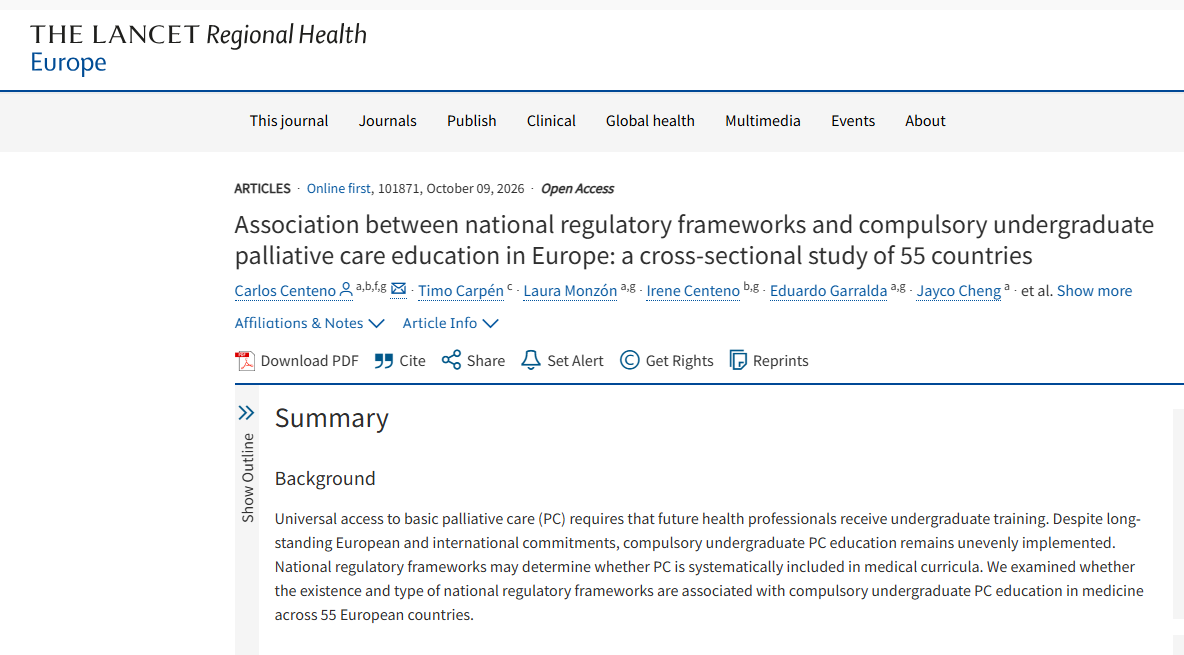
Only 15 of 55 European countries ensure that all future doctors receive compulsory palliative care education during medical school. A new study in The Lancet Regional Health – Europe, part of the prestigious Lancet family of journals, shows that compulsory teaching is more widespread in countries with national rules or recommendations.
The study was led by Carlos Centeno, Director of the ATLANTES Global Observatory of Palliative Care at the University of Navarra, in collaboration with the European Palliative Care Research Centre (PRC) at Oslo University Hospital and the University of Oslo.
The research forms part of the education work within JANE-2’s European Network of Expertise on Palliative Care. The network is led by Professor Stein Kaasa at PRC, Oslo University Hospital, who is also a co-author of the study.
The findings are being shared to mark World Hospice and Palliative Care Day on 10 October, an international awareness day highlighting the importance of palliative care for people with serious illness and their families.
Unequal access to education
Palliative care aims to prevent and relieve suffering and support quality of life for people with serious illness and their families. These competencies are relevant to doctors across all specialties.
The researchers used data from the EAPC Atlas of Palliative Care in Europe 2025 and reviewed national rules and recommendations. Only 15 of the 55 countries have compulsory palliative care teaching in every medical school. In 17 countries, no medical school provides compulsory teaching in this field. Where future doctors study therefore matters for whether palliative care is a required part of their education.
Educating future doctors in palliative care has implications for patient care for years to come. Carlos Centeno highlights how learning to relieve suffering during medical school can shape doctors’ approach to patients throughout their careers, whatever their specialty.
He stresses that this education is essential for all future doctors: “It is neither optional nor negotiable, but an essential requirement, aligned with the needs of society and with the fundamental values of the medical profession.”
National frameworks matter
Both binding rules and non-binding national recommendations were associated with more widespread compulsory teaching.
France and Finland illustrate two different approaches. France requires palliative care in medical education by law, while Finland uses national recommendations. In both countries, palliative care is a compulsory part of the curriculum in every medical school.
Strengthening education and patient care across Europe
The findings provide an important evidence base for JANE-2’s Network of Expertise on Palliative Care and its dialogue with universities, national authorities and professional organisations about strengthening medical education.
The network’s education work spans undergraduate, postgraduate and specialist training. Alongside its work on the organisation of services, care pathways and quality indicators, the aim is to integrate evidence-based palliative care into routine clinical practice and support timely access according to patients’ needs, across healthcare settings and levels.
“All doctors need basic competencies in palliative care. This study highlights substantial differences in access to compulsory teaching across Europe and provides an important foundation for our education work. In JANE-2, we work to ensure that knowledge of palliative care is used in everyday patient care across Europe, so that patients receive the care they need, when they need it, at all levels of healthcare,” says Professor Stein Kaasa, co-author and leader of JANE-2’s Network of Expertise on Palliative Care at PRC, Oslo University Hospital.
Article and funding
Centeno and colleagues. Association between national regulatory frameworks and compulsory undergraduate palliative care education in Europe: a cross-sectional study of 55 countries. The Lancet Regional Health – Europe.
https://www.thelancet.com/journals/lanepe/article/PIIS2666-7762(26)00283-8/fulltext
The study was funded by JANE-2, co-funded through the European Union’s EU4Health programme (Grant Agreement 101183265), and ICS–ATLANTES.